The New Climate Foresight
A professional briefing on strategy in an age of accelerating discontinuity.
Delivered live by Alex Steffen on June 26, 2026.
A single, one-time professional briefing for climate foresight practitioners and serious adjacent professionals who sense that something fundamental has shifted in the strategic landscape — and want the conceptual tools to name it, understand it, and work with it.
What has changed
For nearly five decades, the core belief animating climate policy and advocacy has been the pursuit of an orderly transition: collective action on emissions, delivered fast enough to limit damage to a level that could be affordably adapted to, with continuity largely preserved.
That belief shaped climate foresight frameworks. It shaped what questions got asked and which ones didn’t. It set the agenda for climate strategy as a professional practice. The orderly transition, though, is a thing of our past.
Climate science is narrowing the range of plausible outcomes. The most extreme high-emissions pathways increasingly appear less useful as central planning assumptions, while significant overshoot of 1.5°C is impossible to avoid. This is important news—but its meaning hasn’t been widely understood.
The narrowing does not make the climate anticipation simpler. It makes strategic uncertainty more urgent. Even relatively successful mitigation now leaves us facing profound disruption, staggering costs, difficult prioritization decisions, and deep impacts across society. The worst-case scenario is no longer “the end of everything.” It is a world in which billions of people, living within largely unchanged systems and communities, must navigate escalating and nonlinear challenges.
The greatest uncertainties in climate foresight are migrating. They now increasingly live in human systems: how businesses respond, how assets get repriced, how communities attempt to adapt, and how the people running our most consequential institutions decide to act in the face of accelerating discontinuity. The center of climate foresight is now response.
This is a new and different problem, with echoing ramifications. It requires different tools.
What’s coming
Most of the popular discussion of what the future looks like — for the economy, for society, for politics — is out of date given the lock-in of a highly discontinuous planetary crisis, bounded by extremely disruptive but non-apocalyptic climate outcomes.
We are entering a period where the strategic substrate is shifting faster than consensus can change. Things are getting demonstrably weirder than many decision-makers feel comfortable discussing openly.
The science is stronger than ever. Multidisciplinary research is illuminating the interconnected complexity and cascading threat potential of living in a society built for a climate we no longer have. Risk discovery is accelerating as a field, and the capacities for measuring risk across multiple dynamics are rapidly improving.
The full force of these innovations, though, will not be felt for years, maybe even a decade or more. What we have today are startup hypotheses, incomplete data sets and evolving models, with assumptions that are defensible by academic standards but questionable for use in strategic frameworks. Today, we know enough to be certain of a large magnitude of discontinuity, without having the tools we need to precisely enumerate its effects. There’s pressure to stick to available orderly approaches until more discontinuous approaches can be quantitatively proven appropriate. Strategically, though, a decade is forever in moments like this.
Meanwhile, billions of people are hurtling towards a collision with their own unreadiness. That collision looks likely to produce nonlinear societal changes: political turmoil, economic turbulence, social decohesion, radical — and often conflicting — responses as people fight to preserve or extend their access to the parts of the economy most likely to survive and grow as the crisis bites deeper.
Leadership and elite consensus remain the structural problem. Institutional decision-makers are still largely operating as if the choice set is: climate change is not yet material OR we can always move faster in an orderly transition to preserve continuity and keep our status quo assumptions workable. This insistence on a non-existent continuity has shaped the institutional frameworks that most of us are operating inside.
The gap — and why it makes this moment dangerous
The delay in recognizing risk (and the transformation it has already set in motion) has left us with outdated ideas about the pace of change — assumptions that transformations we’re seeing now remain in the future. Refusal to price known risks into the value of major assets, systems, and geographies. Predatory delay and intentional political polarization that have produced climate hushing, triangulated climate strategies, and the institutionalization of foresight frameworks that still talk of physical and transition risks as if we were in an orderly transition.
Triangulation — the practice of pairing serious-sounding commitments to big-but-distant goals with incremental and inexpensive near-term steps, held together by arguments that small steps today are “in line” with a future of bold action — has become the dominant professional offering in climate and sustainability work. Its primary deliverable is the claim that its employer is “doing enough.” It is purpose-machined to preserve the value of slow approaches, existing assets, and outdated expertise. By their nature, triangulated approaches demand that a boundary be set and defended — a cap on the pace and extent of change that is “realistic” to consider. Discontinuity must be defined as not relevant for current strategy.
That makes practitioners more secure in their jobs for now, and less prepared for the future. It makes organizations better protected from near-term pressure — in part by being able to claim ESG progress — and worse at strategy. Practitioners who have accepted the triangulated frame as the legitimate limit of serious analysis are doing rigorous work on the wrong questions.
Ironically, climate foresight has become institutionalized at exactly the wrong moment. Organizations hired smart people, built effective teams, adopted the frameworks — and now those frameworks are calibrated for a world that’s receding faster than the models predicted. So the professionals who did everything right are now operating with tools that are quietly losing resolution. Every quarter that foresight practitioners and users keep employing frameworks calibrated for managing transition rather than facing discontinuity is a quarter where their advice is quietly degrading in quality. There is real danger in climate foresight practitioners locking in new work based on outdated assumptions at the very moment those assumptions fall apart as guidance for near- and medium-term strategies.
What this briefing is, and is not.
Serious climate foresight and strategy need to work in the half-light zone where evidence is available but not conclusive, escalating risks are visible but not predictable, and the best opportunities demand investing in disruptive capacities for thriving in ongoing discontinuity. In other words, we need to be building strategies for the uncertain and fast-changing world we have, not pretending the world is still predictable and orderly so our strategies appear to remain valid.
We don’t yet have good sensemaking rubrics for the parts of climate foresight that must extend beyond the climate science — but this wider view is strategically essential.
This briefing explores the questions serious practitioners need to be asking, the assumptions that need to be interrogated, the emerging approaches that are proving more useful under conditions of accelerating discontinuity.
I’ve spent years focused on better understanding what foresight means in discontinuity. I don’t have all the answers. This is a field report and an invitation to a thoughtful conversation.
You won’t get a precise roadmap for action or a list of actions to take tomorrow.
What you will leave with:
- A clearer diagnosis of which parts of your current practice may be losing reliability and why.
- Language for new dynamics your organization may not yet have named.
- A framework for working with incomplete evidence.
- A sharper sense of where the field is heading and what deserves the investment of your time and resources now.
This briefing is a beginning, not a conclusion — but it is a beginning grounded in an up-to-date synthesis of the best tools for understanding the discontinuity most professional discussions are still structured to avoid.
We’ll explore questions like:
The state of climate forecasts.
Why the science is only the start.
The declining usefulness of triangulated strategies.
The current gap between risk discovery and strategic needs.
Decision-narrowing under deep uncertainty.
Strategic intuition as a professional response to thin quantifiable analysis.
Moving from physical and transition risks to discontinuity and response upheavals.
Horizon-scanning complex human systems.
History as the secret tool of futurism — and why discontinuity is testing its limits.
Spiky solutions and competitive optionality: what happens when foresight becomes a race for remaining room to maneuver.
A field-scan of emerging approaches.
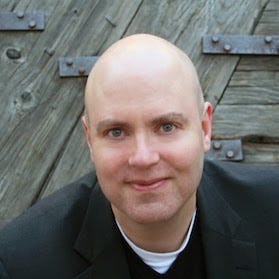
Alex Steffen has spent 35 years developing and continuously revising his climate foresight practice — as co-founder of the influential sustainability solutions publication Worldchanging, as Planetary Futurist in Residence at IDEO, and as the writer behind The Snap Forward newsletter.
His thinking on discontinuity and the limits of orderly-transition strategies has been profiled in the New York Times Magazine and pressure-tested across years of direct engagement with practitioners navigating a world in upheaval.
Born from his foresight practice, Alex's acclaimed personal climate strategy classes and workshops have helped nearly 600 people from across the U.S., Canada, the U.K, Europe, Australia, India, and New Zealand to chart their own courses through uncertainty. He has deep knowledge of the field, and a front-line perspective on why it’s changing so quickly.
“There are two kinds of futurists. The first explore the variations of what exists and project the future from those tea leaves. The second, and by far the rarer, peer around the curve of time and reimagine the future as much as foresee it. Alex Steffen is the latter!”
“Consistently, Alex Steffen is one the world’s shrewdest thinkers about this fraught moment in human history. ”
“When CEOs want to navigate the world's mega-challenges and prepare for a volatile world, they look to business strategists like me. And when business strategists want to challenge and hone our own thinking about the future, we look to Alex Steffen.”
The briefing will be recorded and the recording will be shared with participants afterwards. You may also join the call late or leave early if needed.
While created with the climate (or climate-adjacent) professional in mind, this briefing should be compelling for anyone with a strong interest in climate foresight and big-picture thinking.
There is currently no plan to offer this exact briefing again.
We’re happy to offer a 40% discount for folks doing good work on limited budgets within non-profits or as individuals.
To claim this discount, please choose a payment option below, and then use this coupon code at checkout: SAVE40NCF (enter the code where it says, “Have a coupon?”).
If you realize that you cannot attend the Briefing after you have signed up, you may request a full refund, less a small 10% processing fee, by Thursday, June 25th at 5pm Pacific. Please email your request to [email protected].
Date: Friday, June 26th
Start Time: 12pm PDT // 3pm EST // 7pm GMT.
End Time: Approx. 3pm PDT
Where: Zoom
The Briefing:
- Two 50-minute presentations (separated by a 10 minute break), delivered live by Alex Steffen.
- A thoughtful group discussion and Q&A led by Alex for approximately one hour.
Afterwards, all participants will receive:
- The full recording
- A Briefing Memo with summarized key concepts and take-aways, plus additional resources.
Space is Limited.
Scroll Down to Save Your Spot ⬇️
Please choose the payment option that works best for you. You may make one payment, or make two equal payments charged automatically 30 days apart.
If you would like to attend with your team, please email us for special pricing at [email protected].
Media/Press: Please email [email protected] before signing up.
One Payment
Two-Pay Option
Questions before you sign up? Please Email [email protected].
"Alex Steffen is an extraordinary visionary."
- Rebecca Solnit, author of Not Too Late